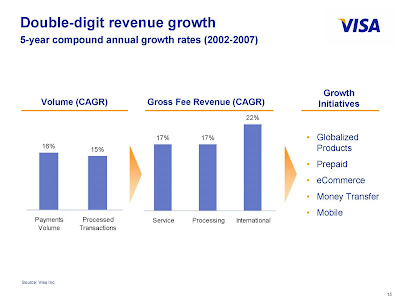
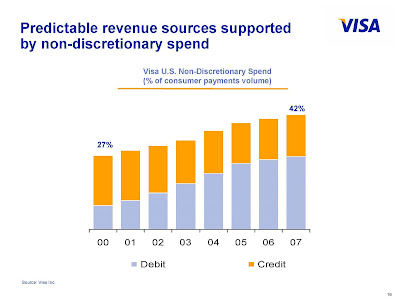
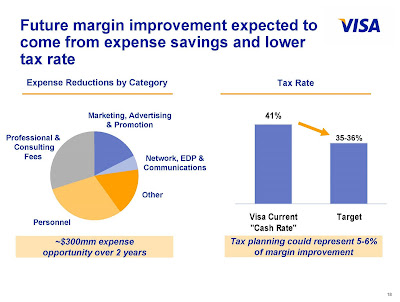
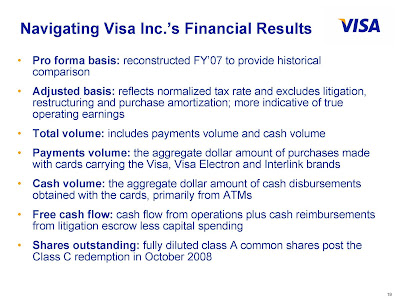
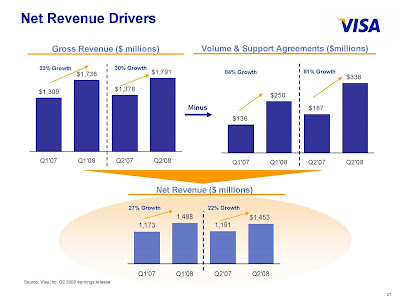
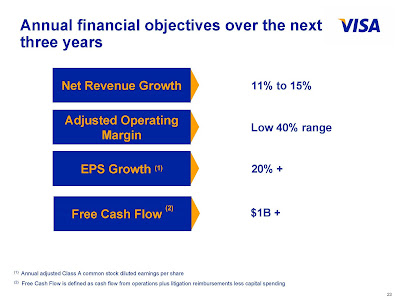
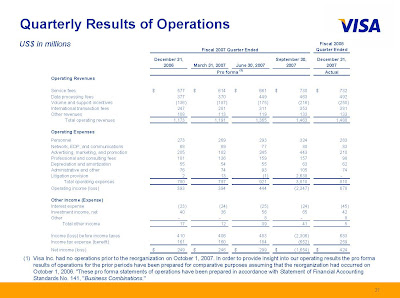
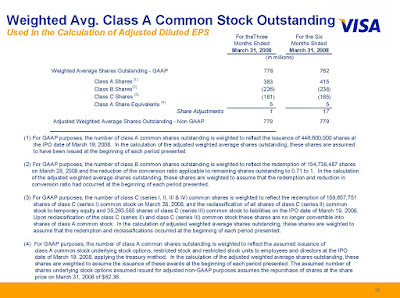
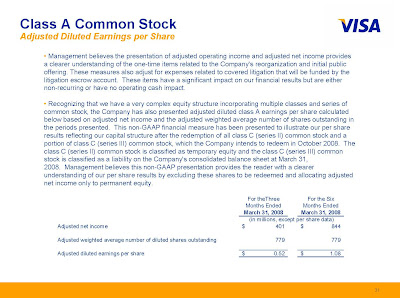
Yeah, check this out folks! Presentation by Visa CEO, Joseph Saunders and Visa CFO Byron Pollitt @ UBS Global Financial Services Conference @ May 14, 2008.
It gives us a good insight of Visa Positioning and Outlook
Highlights @
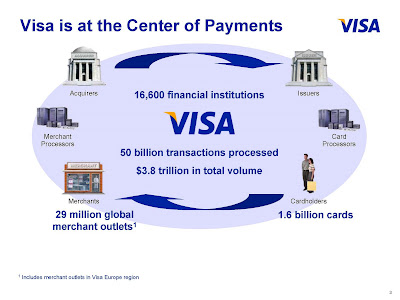
Slide 6, Visa is rapid growing around the world
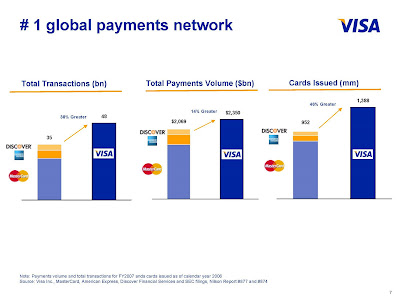
Slide 7, Visa is #1 payments network
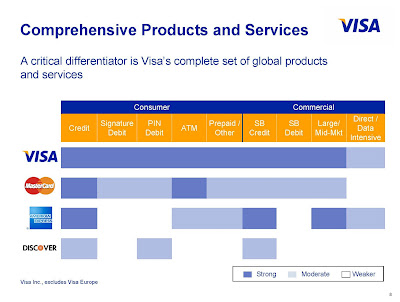
Slide 8, for Visa Products and Services Differentiator with competitors like Mastercard, American Express, Discover.
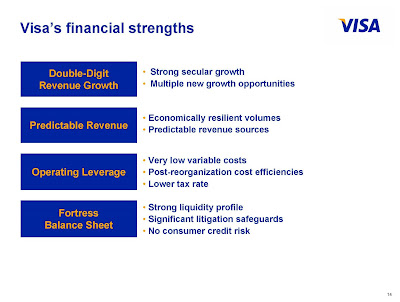
Slide 14, for Visa Financial Strength Highlights
Slide 17, uninterrupted growth even during recession year of 1991 and 2001!
** Basically, it will be our shelter for rainy days and stormy economy ahead.
From looking at Straddles, which thrive on volatility, we now take a look at a strategy that's much more conservative. It's so conservative that some retirement funds allow this strategy in their portfolio.
Writing Covered Calls are a "moderate" investor's favourite strategy. It works particularly well when the stock in question doesn't move dramatically up or down, but rather just trends sideways.
Basically, it works for stocks that are deemed too "boring" for option plays.
***** Writing Covered Calls is an extremely conservative strategy that works best on stocks that don't move much in price. ******
So far, we've only considered buying options. For writing Covered Calls, we need to take a look at the opposite side of that transaction, which is selling stock options . The term "writing" refers to the act of selling stock options. So when we write covered calls, we are actually selling a call option.
To recap, buying a call option gives you the right, but not the obligation, to buy a stock at a specified price at a specified date. Conversely, if you sell a call option, you now have the obligation to sell the stock to the option buyer at the agreed upon price at the specified date.
Taking a look at our housing example earlier on, the owner of the house basically wrote / sold an option to us by promising to sell us the house at the agreed price. We could decide whether we wanted to buy the house, but if we did want to buy it, the house owner is required to sell it. He does not have the luxury of saying no.
So a Call Writer is agreeing to the obligation to sell stock, while a Put Writer is agreeing to the obligation to buy stock.
***** When you are Writing or Selling stock options, you are agreeing to the obligation to fulfill the option contract, which is to sell stock in the case of a Call, or to buy stock in the case of a Put. *******
Scary isn't it? Who would want to enter a contract with such obligations?
The good part is, when you sell an option, you receive the Premium of the option. Which means you instantly make money from a transaction.
In that case, why doesn't everyone start selling options?
Let's take a closer look at selling Call options.
To recap: when you buy an option, you buy the option to Open a Position, and sell it later on to Close the Position. Similarly, when you Write options, you write the option to Open the Position, and you must Close the Position somehow, whether it's by letting the option expire worthless, or by buying the option back.
In the case of selling Call options, remember that Call options are more In-The-Money the higher the stock price goes. So if you sell a Call option and the underlying stock price goes down below the option's strike price (meaning the option becomes Out-Of-The-Money), the option will expire worthless. You therefore don't need to do a thing, and can pocket the profit you earned by selling the option.
However, the danger happens when the stock price keeps climbing. If it keeps going up, it will never become worthless, and come expiration day, someone is going to exercise the option and buy the stock from you. You have been Called Out.
The problem is, you don't own the stock! You would need to buy the stock at the current market price (which has gone up), and sell the stock to the option buyer at the previously agreed strike price, which would have been lower. This would cost you a lot!
Let's take a look at a numerical example:
Say the price of stock ABC is now sitting at $18. You sell a Call option for a strike price of $20, expecting the stock to hover around the $18 level. Let's say you earned $1.00 on the option premium (which is $2 Out-Of-The-Money).
Scenario 1: If by expiration day the stock price ends up at $19, which is below the strike price of $20, you're fine, since the option is Out-Of-The-Money and will expire worthless.
Scenario 2: What if by expiration day the stock price jumps to $26? The option is now In-The-Money by $6, and you have been Called Out. So you will need to buy the stock at the current market value of $26, then sell it to the option buyer at $20. That's a loss of $6 for you, and if you include the $1.00 you made earlier, still results in a nett loss of $5.00.
Let's look at this in tabular format:
ABC
Scenario 1
Scenario 2
Premium Earned
$1.00
$1.00
Strike Price
$20
$20
Final Stock Price
$19
$26
In-The-Money?
Out $1
In $26
Cost of Stock Purchase
---
$26
Earnings from Stock Sale
---
$20
Total Profit
$1.00
- $5.00
And that's just if the stock price goes up to $26. What if it had gone higher, to say $36? Your losses would increase by another $10. Considering that one contract covers 100 underlying shares, that's a lot of money. Therefore, selling stock options on their own, also known as selling Naked or Uncovered options, is extremely risky.
****** Selling stock options on their own is known as selling Naked or Uncovered options. They are extremely risky, and can result in unlimited losses. ******
In order to lessen that risk, what we can do is to actually buy the underlying stock the same time we sell the option. For example, if you want to sell 1 contract of ABC options, you would buy 100 shares of the ABC stock at the same time (remember that 1 option contract is equivalent to 100 underlying shares).
By buying the shares, we eliminate the risk of having to buy the shares later at a higher price in case we get called out. This is called covering your call writing, ie. we just wrote a Covered Call.
Let's return to our numerical example, but this time we write covered calls on it. Previously, we sold a $20 Call option for a premium of $1.00 when the stock was currently at $18. This time, we also bought 100 shares of the stock at $18.
Let's look at 2 scenarios, one where the stock went down in price, and another where the stock climbs above the option strike price.
Scenario 1: If the stock price falls to $17 by expiration day, the option expires worthless and we are not called out. We lost $1.00 because we bought the stock at $18 and it's now at $17. However, since we previously sold the option for $1, we actually broke even. And we still own the stock.
Compare this with just a simple purchase of the stock. When we write covered calls, ie. selling an option together with buying the stock, we actually increase our loss tolerance by the option's premium amount. In this example, we increased out loss tolerance by the option premium of $1, meaning we could afford to have the stock drop $1 without actually losing anything.
That is our break even level. As long as the stock price stays above that level, we profit. Anything less and we lose. That's why we need to look at stable or moderately bullish stocks to consider for writing covered calls.
This is important in the stock market, where stocks we buy usually don't go up the way we expect them to...
Scenario 2: If by expiration day, the stock goes up to say $26, we would be called out. However, there is no risk, because we already own the stock, and can just sell it immediately.
However, since we already agreed to sell the stock at $20, that is the price we have to honor. So we sold the stock at $20. In total, we earned $2 from selling the stock ($20 minus the $18 we spent earlier), and earned another $1 from selling stock options earlier on. That's a total $3 profit.
Let's look at this in tabular format:
ABC
Scenario 1
Scenario 2
Cost of Stock
$18.00
$18.00
Premium Earned
$1.00
$1.00
Strike Price
$20
$20
Final Stock Price
$17
$26
In-The-Money?
Out $3
In $26
Earnings from Stock Sale
---
$20
Change in Value of Held Stock
-$1.00
---
Still Keep the Stock?
Yes
No
Total Profit
$0.00
$3.00
Now let's take a look again at Scenario 1. The Call option has expired worthless, and we keep the stock. This means that month after month we can keep selling stock options on those 100 shares we own, and as long as we don't get called out, we can make constant monthly income! And what if we get called out? As Scenario 2 shows, getting called out still earns us a profit!
This is how investors write covered calls to generate a monthly income. This strategy usually earns about 3% to 15% a month. Not bad for a strategy that's almost risk-free!
However, do note that if you are unlucky enough to choose to buy a stock that keeps falling lower and lower, no strategy is going to help you! (Unless you buy a Put option on that stock to reduce your losses).
***** We write covered calls by buying stocks to cover an option sale. This is a conservative strategy that can be used to create monthly income, by selling call options month after month. **********
On a side note, some investors who have held particular stocks that haven't moved for a long time can also decide to write Covered Calls. They can sell call options their stock, and either earn monthly income on the stocks, or (sometimes hopefully!) get called out and sell their stocks, getting back their capital to invest elsewhere.
Options can also be used in ways that produce profits on a consistent basis. All option contracts expire. This is a certainty. In fact, not only do we know that they will expire but we also know precisely when they will expire. The only question we cannot answer ahead of time is whether the underlying stock price will be above or below the options strike price.
The strike price is that price at which, in the case of a call option, the option holder may purchase or, in the case of a put option, sell the underlying stock. If you own a call option, you would have the ability to buy the stock at the strike price. If the stock is trading at a price level higher than the strike price your call option will allow you to purchase the stock at the lower strike price.
What this also means is that if you sold that same call option, your option would expire worthless so long as the stock price remains below the level of the strike price.
Conversely, a put option allows the buyer of that option to sell the underlying stock at the strike price, so if you sell a put option, your option will expire worthless so long as the stock price is above the level.
When you sell an option, you receive a cash payment to your account. You remain obligated to perform upon that short option until such time as it expires or you close the contract by repurchasing it. Because options expire on a known date, if you are able to identify a where a stock is likely to trade, or where it is not likely to trade, it may then be possible to sell call options above that range or put options below that range.
If you are correct in your assessment of the market, those options will expire worthless and you can keep the entirety of the premium that was paid into your account without further obligation.
Selling options is not without its risks, but there are methods of curtailing those risks significantly.
One of the more favorite tools of sophisticated options sellers is the vertical credit spread. This involves that simultaneous purchase and sale of two options. The technique allows the option seller to still capture premium, but a cheaper option is purchased to limit the maximum risk. It is possible to limit your risk to less than $100 per trade.
Monthly premium income can be created in a safe, reliable manner by identifying key areas of support and resistance in the market. Selling stock options using a limited risk strategy, such as the vertical credit spread, preserves the high probability of success while also limiting the risk involved in an unexpected market move.
To learn more about vertical credit spreads, visit TheOptionClub.com and register for their free stock option trading lessons and newsletter.
-------------
Relationship between Stock/Security and Options
The premium, is the amount you receive when you sell an option, or conversely, the amount one would pay to buy an option.
For example, XYZ is trading at $50 per share and the XYZ October 50 call is trading at $5.00 per share. The $5.00 per share cost for the XYZ October 50 call option is referred to as the premium.
The premium reflects the risk in the underlying security. Risk being defined in terms of volatility, which simply quantifies how dramatically the underlying security can move up or down from its current price level. Without belaboring the point, the more volatile the underlying security, the higher the option premium.
Knowing that options and risk are inexorably linked, we come back to our original thesis; how much income does your hypothetical $100,000 nest-egg need to produce?
We’ll begin by purchasing 1,438 shares of the Canadian Imperial Bank of Commerce (symbol CM, listed on the TSX) at $69.50 per share.
At the same time, we’ll sell 14 CM January (2006) 70 calls at $3.20 per share. These call options obligate you to deliver 1,400 of your 1,438 shares at $70 per share to the call buyer anytime between now and January 2006. If the stock is called away at $70 per share, you receive $98,000 plus you will still own 38 shares worth at least $70 per share ($2,660 total value fort the additional 38 shares) for the for a total portfolio value of $100,660 ($98,000 for the shares that were called away plus $2,660 for the shares that did not have options written against them).
Here’s where comfort comes into play. You need to ask how comfortable are you that CIBC will be worth at least $70 per share 11 months from now. If you are comfortable with CIBC, the next step is to look at what kind of income you can generate with this strategy.
First of all, you have the call option premium that can be paid out over the next eleven months. You received $3.20 per share in premium income multiplied by 1,400 shares for a total value of $4,480. The option premium income is taxed as a capital gain if it is earned outside an RRSP.
You will also receive three dividend payments over the life of this position. CIBC pays 65 cents per share in quarterly dividends which works out to $1.95 per share in total dividends received over the next 11 months. Based on the 1438 shares purchased, you will receive an additional $2,804 in dividend income. The total cash flow from this position over the next 11 months is $4,480 in capital gains income plus $2,804 in dividend income for a total income of $7,284 (that represents a monthly income of $662). This is what could be paid out over the next 11 months without impinging principal. Assuming, of course, CIBC is above $your $69.50 purchase price in January 2006, and assuming that CIBC maintains its’ current dividend.
Having vetted the risks, we’ve now come full circle. The initial objective was $8,000 per year or $666.67 per month, in pre-tax income. With the CIBC covered call write example, about two thirds of the cash flow is capital gains (the option premium), the remaining one third being dividends. Over the next 11 months, you would draw income at a rate of $662 per month, just slightly below your goal.
The worst case scenario would see the value of CIBC shares decline below $69.50 per share. In this case, you retain the shares but may not be able to capture enough premium income to satisfy your needs for the next year. And we define the risk by asking the question; how comfortable are you the worst case scenario?
Of course this was meant as an example of an alternative source of income. In reality, you would want to hold a number of dividend paying stocks to provide the portfolio with some reasonable diversification.
** Bookmark/Subscribe/RSS this page, I will update often, because I am a Visa Investor :D ** Pls share if you have other good resource, dump the link at the comment of this page. I will update this posting. Tx.
S&P Market Scope Research Notes 2008-05-19 09:30:18.000 V "Based on double-digit transaction and payment volume growth, we look for V, the world's largest retail electronic payment network, to grow its revenue 21% in FY 08 (Sep.). We are encouraged by growth trends outside the U.S., particularly in emerging market countries. We also favor V's high percentage of debit cards, as we believe, based on dwindling cash usage, that this is a high-growth segment. We look for EPS of $2.00 and $2.53 in FY 08 and FY 09, respectively. Our 12-month target price of $87 equates to 34.4X our FY 09 EPS estimate, a premium to peers.US V14234110808544"
Deborah Owen, Robin Griffiths, "Mapping the Markets: A Guide to Stock Market Analysis" Bloomberg Press; 1 edition (November 1, 2006) | ISBN:1576602389 | 134 pages | PDF | 1,3 Mb
In this guide to stock market analysis, the authors offer a global overview of business cycles and their impact on financial markets, explain how stock markets are affected by the cycles and by seasonal and secular trends, and show readers how to identify sectors and stock in which to invest.
Patrick L. Young, Charles Sidey , Patrick Young, "Single Stock Futures" Wiley; 8th edition (April 8, 2003) | ISBN:0470853158 | 320 pages | PDF | 1,4 Mb
Single Stock Futures are regarded by many as the ultimate derivative. Having finally made their US trading debut in November 2002, the market is set for explosive global growth during 2003 and 2004. Written by experienced traders, this is the first practical guide to this exciting new product as increasingly traded throughout the world.
Jack D. Schwager "Stock Market Wizards: Interviews with America's Top Stock Traders" Collins ISBN: 0066620597 352 pages PDF1 Mb
Newcomers to Jack Schwager's series on top traders, as well as fervent fans of his first two entries Market Wizards and The New Market Wizards, will find that Stock Market Wizards offers another revealing look at a wide spectrum of trading styles through the eyes of 15 extraordinarily successful individuals. Transcripts of incisive Q&A sessions between Schwager and traders--including Michael Lauer, Dana Galante, Alphonse "Buddy" Fletcher Jr., and Claudio Guazzoni--examine the ways each approaches their specialty, whether it be value stocks, mutual funds, short selling, options trading, or other market niches. After brief but interesting introductions that place the subjects' trading practices into perspective, Schwager coaxes from them penetrating observations on setting goals, finding opportunities, learning from mistakes, and operating on a day-to-day basis. While some participants refuse to divulge proprietary practices, and Anthony admits that many traders' activities hold little relevance to individual investors, the basic doctrines nonetheless contain nuggets of wisdom that can be applied by many nonprofessionals. And, in the final "Wizard Lessons" chapter, Schwager details the 65 overarching principles (such as Trade Your Personality, Be Willing to Take a Loss, and The Importance of Setting Goals) he culled from these extensive conversations. --Howard Rothman --
Of the 100 suburbs most speedily spreading, California has the fastest, Arizona has the biggest and Texas has the most. ( By Matt Woolsey, Forbes.com )
Los Angeles is sometimes called the "Sultan of Sprawl." But you wouldn't know it by looking at the country's fastest-growing suburbs. Not a single one falls in the L.A. metropolitan area.
Instead, Angelenos are packing their bags and heading 60 miles east to San Bernardino, where 12 of the country's 100 fastest-growing suburbs are located. Leading the pack? Beaumont, which has grown 130% since 2000.
It's easy to understand why. Home prices in the Riverside-San Bernardino metropolitan area are 30% less expensive than in L.A., and household incomes are comparable.
The move from basin to valley makes enough sense that San Bernardino's rate of net domestic migration has near quadrupled since 1990, while the Los Angeles metro area posted negative net migration figures over that same period. Last year, it lost 72,000 more residents than it gained.
Our list was compiled using U.S. census growth data from 2000 to 2006 and provided by Demographia, a St. Louis research firm. Demographia excluded outlying towns that were in suburban counties but didn't have significant economic and social ties to the big city. Suburbs included cities, townships and villages that had more than 10,000 people in 2000.
Behind the numbers
The fastest-growing suburb in the nation is Lincoln, Calif., just outside Sacramento. Its population jumped from 11,746 to 39,566, an increase of 236%. The Sacramento area isn't cheap by national standards, but it's growing because it's a less-expensive alternative to Los Angeles, San Francisco or San Diego.
The fastest-growing big suburb (with a population of 100,000 or more) is Gilbert, Ariz., outside Phoenix, which grew from 112,766 people to 191,517. The Phoenix area saw the greatest positive domestic migration of any American metro area last year, with 115,000 more people moving into town than leaving. Affordable housing and a growing economy are draws for the city.
Texas has the lion's share of the country's 100 top-growth suburbs, with 20. (Twelve of these are in the Dallas-Fort Worth metro area.) That's partly because geographic growth is almost completely unregulated in the Lone Star state. Sprawl has its pros and cons. These areas have some of the most affordable homes in the nation, because there is plenty of supply to meet demand. But transportation expenses are often high. In Houston, transportation costs are the No. 1 household expense, according to the Brookings Institution.
Cities that engage in restrictive growth policies find themselves with different trade-offs. In Boston's inner suburbs, including Chelsea and Cambridge, zoning and growth restrictions designed to prevent sprawl instead force people to look farther outside the city for affordable housing. According to the same Brookings Institution study, metro areas with growth-exclusion plans have the most expensive housing in the country, because there is a limited supply of homes close to the city.
Last year, about 16,000 more people left the Boston metro area than moved in, and the suburbs continued to expand geographically. The result is a thinning of the area. If sprawl is defined as the density of population over a geographic space, that makes Boston more of a sprawl than places such as Phoenix and Las Vegas, which are spreading out faster but with a more concentrated population.
Rounding out the top 10 fastest-growing suburbs after Lincoln were four Phoenix suburbs: Buckeye, Surprise, Goodyear and Avondale; Plainfield, outside of Chicago; Beaumont, outside of San Bernardino, Calif.; Frisco and Wylie outside of Dallas; and Woodstock, outside of Atlanta.